

.svg)

If we truly appreciate whistleblowers, why do so many employees still stay silent?
Most organizations already have a reporting channel and a policy. What they often lack is the trust that makes employees willing to use them. A look at why people stay silent, and what earns their trust.

In honor of National Whistleblower Appreciation Day, July 30, 2026
Across more than two decades of working with organizations of every size, from fast-growing companies to some of the world's largest global enterprises, we've learned that the hardest part of ethics and compliance isn't the technology or the policies. It's trust.
As Head of Sales for our US division, I'm honored to put my own experience to work supporting chief compliance officers, HR leaders, legal teams, investigators, and executives as they build trustworthy cultures. Across those conversations, one question comes up again and again: how do you build a culture where people actually feel safe speaking up?
That question shapes how I work and how I lead. One of my priorities is making sure my own team knows they can raise concerns, challenge ideas, and give honest feedback without fear. I want people to trust the company and me enough to speak openly. And when the safest route is to stay anonymous, they should have that option and the confidence that someone is still listening.
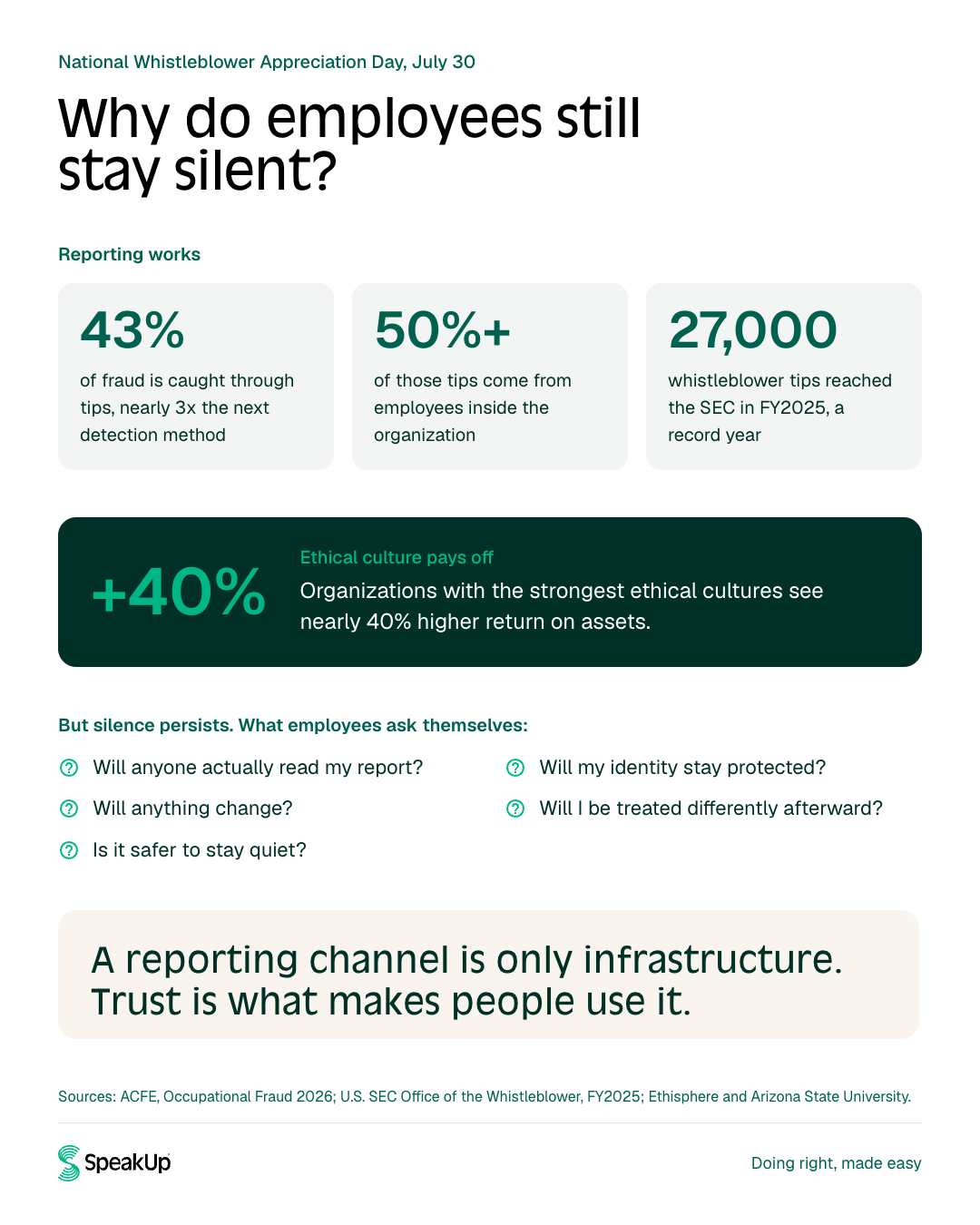
When people feel safe enough to speak, organizations don't just get more compliant. They get stronger, they catch problems earlier, and they make better decisions. The payoff is financial as well: in research from Arizona State University, organizations that scored one standard deviation above the benchmark on Ethisphere's Culture Quotient realized nearly 40% higher return on assets than comparable companies.
That is why National Whistleblower Appreciation Day matters to me. On July 30, 1778, while the United States was still fighting for independence, the Continental Congress passed what is widely recognized as the country's first whistleblower protection law. It set a principle that was remarkable for its time: people had not only the right to report wrongdoing, but a responsibility to do it.
Nearly 250 years later, we still mark the courage of people who speak up. Their reports have exposed fraud, protected public safety, uncovered corruption, and strengthened organizations from the inside. But appreciation raises a harder question. If we value the people who speak up, why do so many employees still choose silence?
The pattern I've seen is consistent. Organizations rarely struggle because they lack a reporting channel or a policy. Most already have both. They struggle because employees aren't convinced it is safe, or worth it, to use them. That is a trust problem, and it takes more than a compliant checkbox to solve.
The cost of silence
Every organization wants people to raise concerns early, before a small issue becomes a headline, a regulatory investigation, or a cultural crisis.
The data backs this up. In the ACFE's Occupational Fraud 2026: A Report to the Nations, tips were the single most common way fraud was caught, uncovering 43% of cases, nearly three times more than the next method. More than half of those tips came from employees. Internal reporting is often the first chance an organization gets to catch misconduct before it grows. In the United States, appetite to report is climbing too: the SEC's whistleblower program received a record number of tips in fiscal year 2025, roughly 27,000, the most in the program's history.
So reporting works. The open question is whether employees believe it will. They ask themselves things that never show up in a compliance manual:
- Will anyone actually read my report?
- Will my identity stay protected?
- Will anything change?
- Will I be treated differently afterward?
- Is it safer to stay quiet?
When uncertainty outweighs trust, silence starts to look like the safer choice.
Trust is the real reporting channel
Most speak-up programs get measured by operational questions: How many reports came in? How many hotline languages do we support? How fast are cases assigned? Those metrics matter, but they skip the one that decides everything. Do employees trust the process enough to use it?
Trust is built long before anyone submits a report. It starts with leaders showing integrity consistently. It grows when employees watch investigations handled fairly. It strengthens when people get updates, even when not every detail can be shared. And it becomes part of the culture when employees see that speaking up leads to accountability instead of retaliation.
A reporting channel is only infrastructure. Trust is what makes people use it.
We've moved beyond the hotline
For years, compliance meant checking a box: install a hotline, publish a policy, satisfy the regulator. Today's workforce expects more than that.
People communicate through smartphones, messaging apps, and AI assistants that respond immediately. When they decide to report misconduct, they expect that experience to feel just as direct. Modern programs have moved well past the phone line to secure web reporting, mobile access, communication in a reporter's own language, and anonymous two-way conversations that lower anxiety rather than adding to it.
Collecting reports is only half the job. The other half is removing friction, because every extra barrier makes it a little more likely that someone decides not to report at all.
Investigations are where trust is earned
Many organizations pour effort into intake and quietly overlook what happens after a report lands. For the person who reported, the investigation often matters more than the reporting experience did.
Was the concern acknowledged, investigated objectively, and handled by the right people? Did leadership act on it? Even when confidentiality limits what can be shared, employees can tell whether a concern moved through a fair, professional process or vanished into a black hole.
Every investigation sends a signal, not only to the person who reported, but to everyone watching. Timely, fair, well-run investigations build trust. Inconsistent or delayed ones erode it.
The right role for AI in investigations
AI is changing every business function, and ethics and compliance are no exception. The useful question isn't whether AI will replace investigators. It won't, and it can't do the part that matters most.
What AI can do is take the administrative weight off investigators' shoulders: summarizing long reports, surfacing similar cases, translating submissions, organizing evidence, pointing to relevant policy, and spotting trends across reports. Judgment, empathy, credibility assessments, and hard investigative calls belong with experienced people.
Used this way, technology supports human expertise instead of standing in for it, and teams spend less time on workflows and more time on the work that strengthens culture.
The future of speaking up
The organizations with the strongest cultures won't be the ones with the most policies or the longest code of conduct. They'll be the ones that earn their people's trust every day. That trust is built when employees know their concerns will be heard, investigated fairly, and acted on; when reporting is simple and accessible; and when leaders show through their actions, not just their words, that speaking up is valued rather than punished.
That conviction is one of the reasons I joined SpeakUp. After years in this industry, I wasn't looking for another reporting platform. I was looking for a team that believed technology should build trust rather than complicate it: tools that remove administrative burden and automate repetitive work so compliance teams can spend their time where they add the most value, which is listening to people, running meaningful investigations, and helping organizations build stronger cultures.
People don't go into compliance because they enjoy managing workflows or wrestling with outdated systems. They do it to protect people, uphold integrity, and help their organizations do the right thing. Technology should serve that purpose.
National Whistleblower Appreciation Day asks us to honor the courage of people who have spoken up throughout history. The best way to honor them isn't a single day of recognition. It's building workplaces where courage is met with trust, where every concern is treated with respect, and where speaking up is seen as the right thing to do rather than a risk to take.
Nearly 250 years after that first whistleblower protection law, the responsibility hasn't changed. Every leader, manager, investigator, and compliance professional, and every technology company serving this field, has a chance to make it easier for people to do the right thing.
If we get that right, maybe one day we won't need to ask why employees stay silent. We'll be pointing to the organizations where speaking up is simply part of who they are.
Sources
- History of the first U.S. whistleblower law (July 30, 1778) and the Senate's annual recognition of National Whistleblower Appreciation Day: nationalwhistleblowerday.org/history
- SEC Office of the Whistleblower, Annual Report to Congress for Fiscal Year 2025: sec.gov
- ACFE, Occupational Fraud 2026: A Report to the Nations: acfe.com
- Ethisphere, on the link between ethical culture and return on assets (Arizona State University analysis of Culture Quotient data): ethisphere.com
- U.S. Department of Justice, Evaluation of Corporate Compliance Programs: justice.gov